Why we organize your LinkedIn content into three pillars
Most founders post one type of content on repeat and wonder why nothing converts. The fix is not posting more — it is posting three specific types in a deliberate ratio. Here is the system behind our content pillars.
The problem with "just post consistently"
The advice you'll hear most often about LinkedIn is "just be consistent." Post every day, or three times a week, or whatever your favorite newsletter says. Consistency is real — but it's not a content strategy. It's a schedule.
I spent six months talking to founders who were posting regularly and seeing nothing. Good writing. Thoughtful ideas. Solid execution. And flat results. The common thread wasn't their cadence or their writing ability. It was that they were posting one type of content on repeat — usually authority content, because that felt safest — and wondering why nothing was converting.
Here's what we figured out: LinkedIn rewards variety, but not random variety. Specific variety. A deliberate mix of what we call the three pillars.
What the three pillars actually are
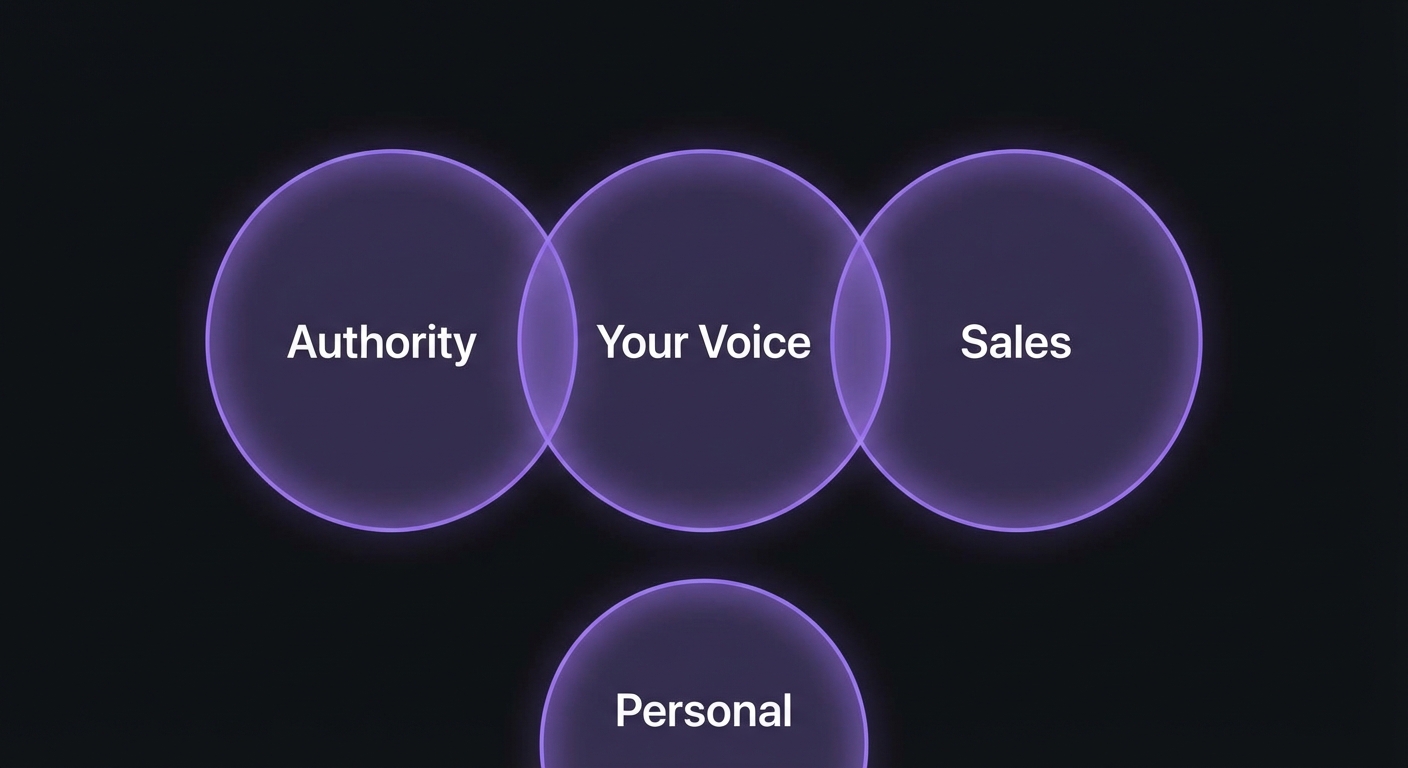
Every post a founder publishes falls into one of three categories: Authority, Sales, or Personal. Most founders post 90% Authority and 10% random. The ratio we've found that works is 2:1:1. Two Authority posts for every one Sales post and one Personal post.
This isn't a made-up framework. It came from looking at which post types drive which outcomes and reverse-engineering the pattern.
Authority posts exist to demonstrate competence before you ask for anything. Not to "share knowledge" as an abstract good — that's not why they work. They work because when someone reads your take on a problem they're wrestling with, and your take is specific and right, they start to trust you. Not "this is a nice person" trust. "This person actually knows what they're talking about" trust.
An Authority post might look like: "Here's the exact go-to-market mistake I made when we hit 50 customers and what I'd do differently." Or: "I've reviewed 40 founder LinkedIn profiles in the last year. Here's what the good ones have in common." It's teaching from experience, not restating what everyone already knows.
Sales posts are where most founders either overdo it or avoid it entirely. One in four posts should connect your expertise directly to an offer. Not every week, not twice a week — once a week. And the trick isn't cleverness. It's specificity.
A bad Sales post: "We help founders grow their LinkedIn presence. DM me to learn more."
A better Sales post: "I worked with a 12-person SaaS company last year. Their founder was posting twice a week and getting zero inbound. After 60 days of working together, three of their posts hit 10,000 impressions and they closed two enterprise deals from LinkedIn alone. If that sounds like your situation, I have two spots opening in March."
The difference is that the second one tells a real story with real numbers and makes the stakes clear. People can see themselves in it.
Personal posts are the ones most founders skip because they feel self-indulgent. They are the most underrated type. Not because vulnerability is a marketing trick, but because founders are human and humans work with humans. A post about the time you made a bad hire, or the week your biggest customer churned, or the thing your kid said that changed how you think about your business — these create connection in a way that expertise alone never will.
The specificity is what makes them work. "It's hard being a founder" is noise. "In November 2024, I almost shut the company down. We had $40K in the bank and no clear path to renewal. Here's the call that changed everything" is a story.
What breaks when you only post one type
Authority-only founders build an audience that respects them but never buys. They become useful resources, not vendors. Every week without a Sales post is a week you're training your network to think of you as a free resource.
Sales-only founders look like ads. Every post is asking for something. Even when the copy is good, the pattern reads as transactional. Trust erodes fast when every post has a pitch attached.
Personal-only founders build warmth but not credibility. People like them. People don't necessarily hire them. "Great person" and "I'd pay them" are different conclusions.
The mix matters because each type builds something different. Authority builds credibility. Sales converts it. Personal makes you someone people want to work with specifically, not just someone with the right skills.
The 2:1:1 weekly rhythm in practice
If you post four times a week, the rhythm looks like this:
- Monday: Authority (tactical insight from your work)
- Wednesday: Authority (opinion or analysis on something in your industry)
- Friday: Sales (specific story connected to an offer)
- One of the three slots rotates to Personal every two weeks
If you post twice a week, alternate: Authority one week, Sales or Personal the next. You won't hit 2:1:1 every week, but you'll hit it across a month.
The rhythm exists to prevent pattern-matching. If you always post Sales on Fridays, your audience will learn to skip Fridays. If your Authority posts come from the same angle every time, they go stale. Variation within the structure keeps it fresh.
What this looks like in the first month
Most founders start with Authority because it feels safe. That's fine. But by week three, you need to have posted at least one Sales post and one Personal post. Not to hit a ratio — to get comfortable with all three modes.
The Sales post will feel uncomfortable. That's expected. The Personal post will feel self-indulgent. That's also expected. Both feelings go away after you see the response.
The three pillars are not a formula for manufacturing engagement. They are a structure for covering the three things your potential clients actually need to see before they hire you: proof you know what you're doing, proof you can help them specifically, and proof you're someone they'd want to work with. Without all three, you're leaving decisions to luck.